
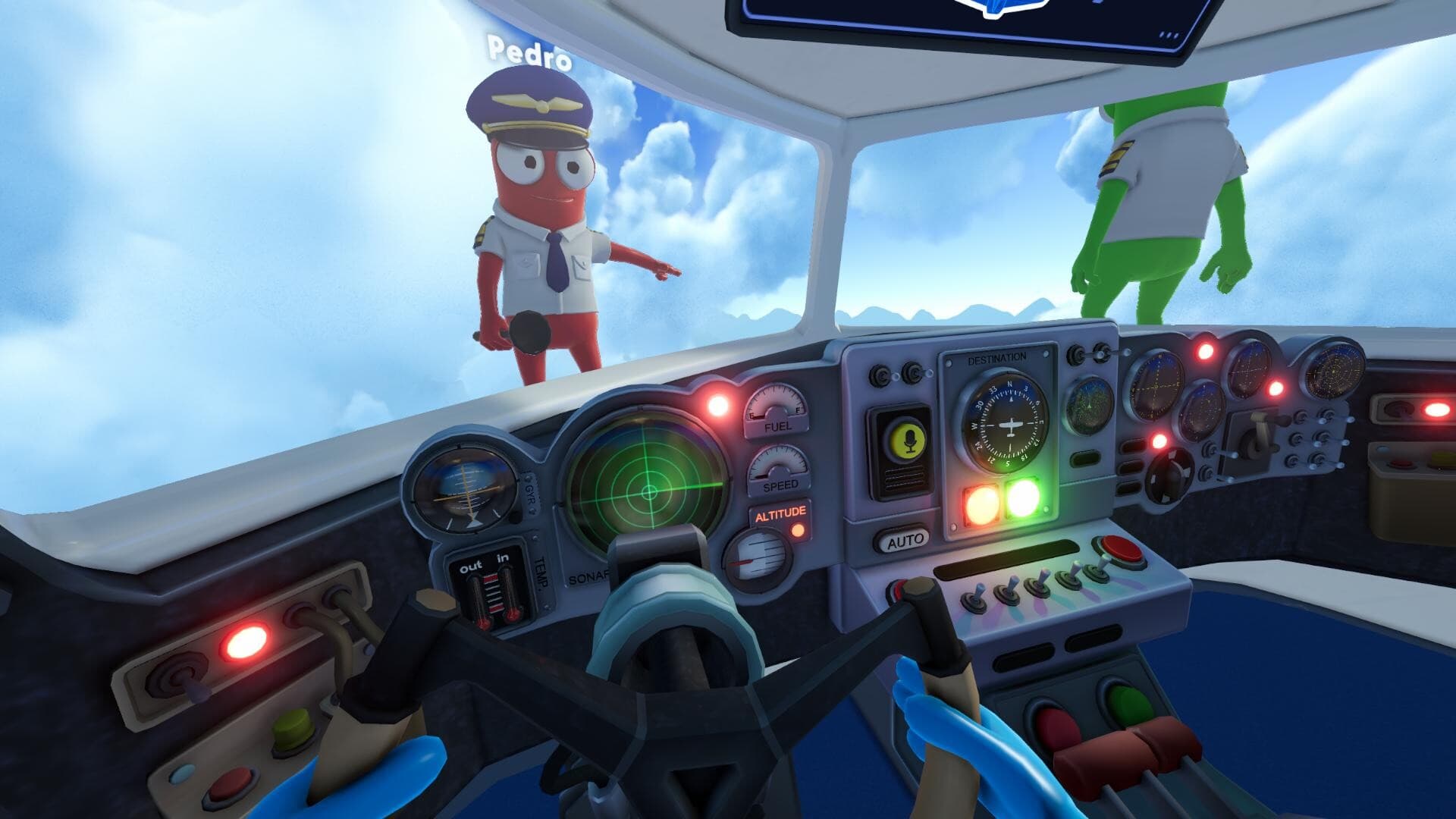
Pilot or cabin crew: what changes?
The pilot is responsible for flying the aircraft; the cabin crew handles passengers, cargo, service, and onboard problems. That division is central to the official description of Dear Passengers. It creates two connected workspaces: the cockpit controls where the plane goes, while conditions in the cabin determine whether the journey stays manageable.
FLEXUS has described the cockpit and cabin jobs, but it has not revealed permanent classes, perk trees, role queues, or the final crew size. Any teamwork tips below come from us, not an in-game tutorial.
The pilot role
Steam explicitly says players can pilot the plane. Promotional screenshots show first-person cockpit controls and status displays, but screenshots alone do not establish the final control scheme or the function of every instrument.
What the pilot is there to do
- Operate the aircraft as the crew works toward the destination.
- Deal with flight conditions connected to dynamic weather, turbulence, and air pockets.
- Work as one part of a crew rather than as a separate flight-only mode.
How we would play it
The pilot should communicate upcoming rough conditions early when possible, keep instructions short, and avoid making dramatic maneuvers without warning the cabin. That is sensible teamwork advice based on the confirmed physics premise—not a claim about a hidden warning system or specific control mechanic.
The cabin crew role
The cabin side combines routine service and damage control. The official description names serving passengers, protecting cargo, keeping passengers under control, and dealing with whatever goes wrong before it becomes worse. Food, drinks, and a smooth flight are presented as passenger expectations.
What the cabin crew is there to do
- Serve and manage passengers during the flight.
- Protect cargo and respond to difficult loads.
- Contain cabin problems before they escalate.
- Adapt when turbulence moves passengers, luggage, and loose objects.
The phrase “cabin crew” describes a job area, not a confirmed single-purpose class. A final build may allow players to switch tasks freely; no official role-lock rule has been published.
Responsibility comparison
| Situation | Pilot focus | Cabin focus |
|---|---|---|
| Normal flight | Maintain the route and aircraft | Passenger service and cabin readiness |
| Rough weather | Manage the aircraft through changing conditions | Control loose people, luggage, and cargo |
| Multiple problems | Share flight-critical information | Triage the most dangerous onboard issue |
| High-risk manifest | Prepare for a more demanding journey | Monitor difficult passengers and cargo |
This table is our simple way of comparing the two jobs. It is not an in-game tutorial or a role chart published by FLEXUS.
A simple team communication system
A chaotic co-op game becomes harder when every callout is equally urgent. We suggest three levels: routine for service work, priority for a growing problem, and critical for an immediate threat to the flight or cabin. Name the location and the requested action each time.
- “Routine: front cabin needs service.”
- “Priority: rear cargo is loose; one crew member needed.”
- “Critical: cabin breach on the left; pilot hold steady if possible.”
These phrases are examples created by this guide. They are not official voice commands and do not imply that the game recognizes spoken instructions.
What happens in single-player?
Steam lists single-player, so you will not need a full group to play. FLEXUS has not explained whether a solo player switches between cockpit and cabin, gets AI help, or receives a lighter workload. Our multiplayer page keeps track of those open questions.
Which role should you choose?
Choose the cockpit if you enjoy sustained responsibility, reading changing conditions, and communicating decisions before they affect teammates. Choose the cabin if you prefer moving between short tasks, reacting to physical chaos, and deciding which passenger or cargo problem matters most.
That recommendation is based on the announced premise. It may change when the public demo reveals the real pace, controls, and difficulty of each responsibility.
Still unknown
- Whether the pilot can leave the cockpit or cabin players can take over controls.
- Whether crew members have unique abilities, equipment, or progression.
- The maximum player count and recommended role distribution.
- How respawning, failure, disconnection, or late joining works.